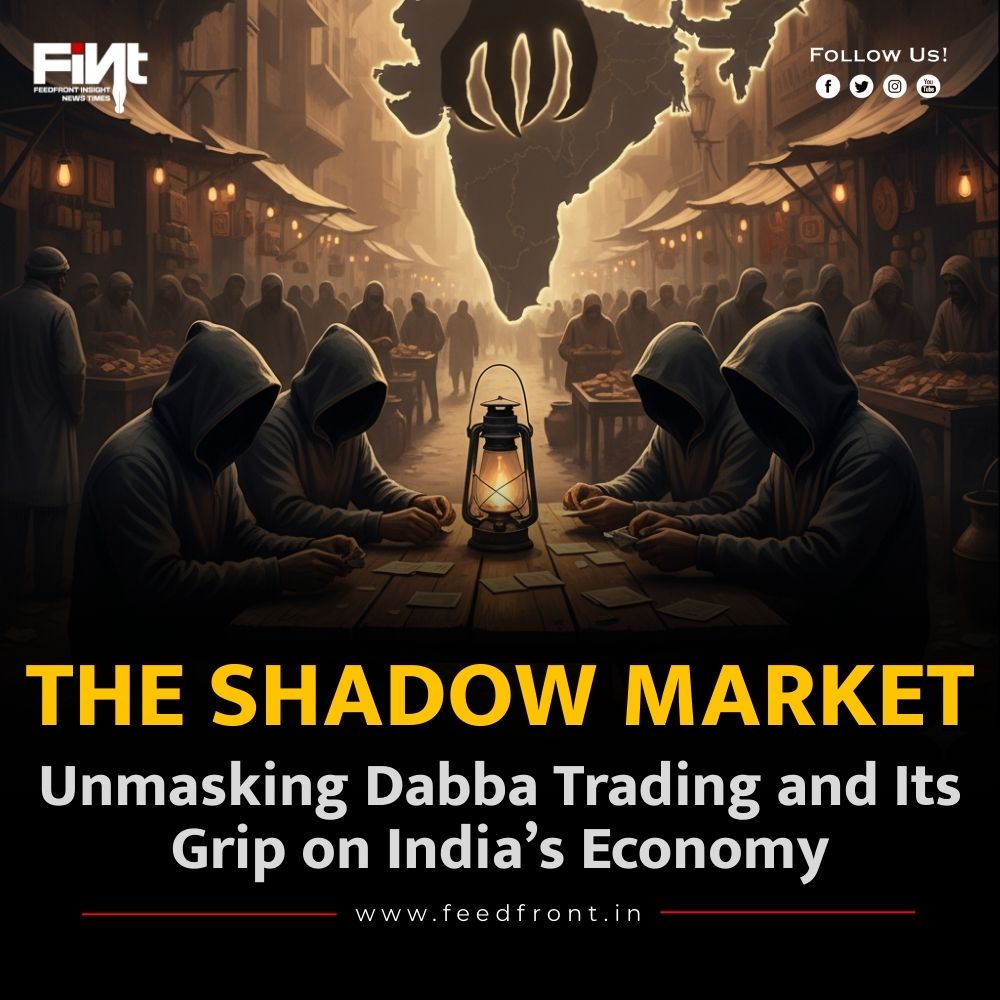


Mumbai: India’s financial system, often celebrated as one of the fastest-growing and most dynamic in the world, hides a dangerous underbelly. Away from the glittering screens of the National Stock Exchange (NSE) and Bombay Stock Exchange (BSE), a clandestine network of unregulated trading known as dabba trading is thriving. It is not a small-time scam but a multi-billion-rupee shadow economy that threatens the stability of markets, drains government revenue, and undermines investor trust.
A Hidden Gamble Behind the Markets
The term dabba literally translates to “box” in Hindi, but in financial slang it refers to the private ledgers maintained by illegal brokers who allow investors to “trade” outside regulated exchanges. Unlike legitimate stock market transactions, dabba trades never enter official records. No shares are bought or sold. Instead, investors place bets on stock price movements, and brokers settle the difference in cash.
Consider this example: an investor bets on a company’s stock priced at ₹1,000. If the stock climbs to ₹1,500, the investor pockets ₹500 from the broker. If it falls to ₹900, the investor pays ₹100 to the broker. These pseudo-trades exist only in the broker’s book, the dabba, while the real exchanges remain untouched.
The attraction is obvious — no taxes, no fees, no paperwork. But beneath this simplicity lies a high-risk gamble, one in which the investor is entirely dependent on the honesty of the broker. With no oversight, no grievance redressal, and no legal protection, dabba trading is little more than a legalized form of gambling dressed up as investing.
Why Traders Risk It
Despite the dangers, dabba trading has gained an almost cult-like following among retail investors and small traders. The reasons are rooted in both economics and psychology:
- Lower Costs: By bypassing regulated exchanges, traders avoid paying brokerage fees, Securities Transaction Tax (STT), and other levies.
- Credit Flexibility: Dabba brokers frequently extend informal credit to clients, something regulated brokers cannot do.
- Speed and Simplicity: Transactions are executed instantly through phone calls, WhatsApp groups, or unrecognized software.
- Tax Evasion: Profits are kept off the books, allowing investors to evade capital gains taxes.
For individuals chasing quick profits, these incentives appear irresistible. But the risks are enormous. Defaults often result in harassment by recovery agents. Investors report cases of withheld profits or complete loss of funds when brokers vanish. Since dabba trading is unrecognized by law, victims have little recourse.
The Wider Economic Consequences
The harm caused by dabba trading extends far beyond unlucky investors. Economists warn that it contributes significantly to India’s shadow economy — the parallel system of untaxed, unregulated economic activity. Estimates suggest that the informal economy accounts for nearly 20–25% of India’s GDP, a staggering figure for the world’s fifth-largest economy.
The consequences are multifaceted:
- Government Revenue Loss: Billions of rupees in STT, capital gains taxes, and transaction fees are lost annually. This shortfall undermines public spending on infrastructure, welfare programs, and social development.
- Black Money Generation: Cash-based settlements create fertile ground for money laundering and hawala transactions. Dabba trading has been linked to organized crime and illicit betting networks.
- Market Distortions: Since dabba trading operates outside formal exchanges, it distorts market signals and reduces the effectiveness of monetary policy and regulatory reforms.
- Erosion of Investor Confidence: International investors may hesitate to pour money into a market where large-scale unregulated trading undermines transparency.
In effect, dabba trading is not just a problem for regulators; it is a national economic threat.
A Global Phenomenon of Informality
The tactics employed in dabba trading are not unique to India. Similar shadow practices exist worldwide, particularly in developing economies where regulatory oversight is weak.
A telling example comes from Uganda’s under-invoicing racket. Importers routinely manipulated invoices and used cash-based payments to evade customs duties. In one case, a container declared at just USD 8,992 was reassessed at USD 16,652 after officials discovered irregular documentation. Another consignment declared at USD 8,002 was uplifted to USD 10,016.
Just as dabba brokers exploit opacity in securities markets, these traders exploited loopholes in customs valuation. The result was the same: massive revenue loss for the government, unfair competition for compliant businesses, and an entrenched culture of informality.
The Crackdown: Raids, Seizures, and Legal Action
Recognizing the danger, Indian authorities have launched aggressive crackdowns.
- The Enforcement Directorate (ED) recently conducted raids in Mumbai, Delhi, Indore, and Ahmedabad, seizing ₹3.3 crore in unaccounted cash, along with luxury cars, watches, and jewellery. Investigators found links to online betting platforms and hawala networks.
- The Securities and Exchange Board of India (SEBI) exposed a massive dabba trading ring in Mumbai and uncovered illicit fund flows of nearly ₹9,000 crore per month in Nagpur.
- Many operators were found using white-label apps — generic trading platforms rebranded for illegal use — making it easy for brokers to attract unsuspecting clients.
Legally, dabba trading is a serious offence under Section 23(1) of the Securities Contracts (Regulation) Act, 1956. Convicted operators face up to 10 years in prison and fines as high as ₹25 crore. Additional charges under the Indian Penal Code, such as cheating and criminal breach of trust, may also apply.
Yet, despite these severe penalties, the trade continues to flourish — a testament to both its profitability and the challenges of enforcement.
Why Enforcement Alone Won’t Work
Experts warn that raids and penalties, while necessary, will not permanently end dabba trading. The shadow market thrives because of systemic issues: lack of financial inclusion, investor ignorance, and a deep-rooted culture of cash-based transactions.
Five-Pronged Path Forward
- Regulatory Reinforcement
SEBI needs broader surveillance powers and closer coordination with agencies like the ED and Income Tax Department. The 2015 merger of the Forward Markets Commission (FMC) with SEBI improved oversight of commodity markets — similar structural reforms are needed for equities. - Technological Upgradation
Advanced tools like Artificial Intelligence (AI), data mining, and blockchain can detect suspicious trading patterns and trace illicit fund flows. - Investor Education
Public awareness campaigns are critical. Initiatives like NDTV Profit’s “Spot The Scam” highlight fraudulent schemes, but more grassroots outreach is required, especially in semi-urban and rural areas where dabba trading often spreads fastest. - Financial Inclusion
Expanding access to formal banking and trading platforms is essential. Government programs such as Digital India and Aadhaar-linked services have made progress, but gaps remain. Bringing small traders into the formal system will reduce the lure of unregulated channels. - International Cooperation
Illicit financial flows often cross borders, making global coordination vital. Organizations like the World Customs Organization (WCO) recommend a mix of enforcement, trade facilitation, and incentives to encourage informal operators to formalize.
A Battle for the Future of India’s Markets
At its core, dabba trading represents more than just an illegal betting system. It symbolizes the larger challenge of formalizing India’s economy, a battle that pits regulatory institutions against entrenched networks of informality.
If left unchecked, dabba trading could undermine the credibility of India’s financial markets at a time when the nation is positioning itself as a global investment hub. On the other hand, effective action against it — through regulation, technology, awareness, and inclusion — could strengthen India’s markets, boost investor trust, and increase state revenues.
Conclusion
The shadow of dabba trading looms large over India’s financial system. For the unsuspecting investor, it is a trap disguised as a shortcut to easy profits. For the government, it is a revenue black hole. For the economy, it is a destabilizing force that erodes transparency and confidence.
The fight against dabba trading is not just about catching illegal brokers. It is about protecting the legitimacy of India’s financial markets and ensuring that growth is driven by transparent, accountable systems.
Until investors, regulators, and policymakers unite to dismantle this parallel economy, the dabba will remain a dangerous box — one that drains India’s prosperity from within.